
We are pleased to welcome Sune Hvelplund as Senior Director at CORIT Advisory
We are pleased to welcome Sune Hvelplund as Senior Director at CORIT Advisory.
Sune brings more than 18 years of experience in international tax and transfer pricing, with expertise spanning strategic advisory, compliance, and complex dispute resolution. He has extensive experience in transfer pricing controversy matters.
Prior to joining CORIT Advisory, Sune was a Director within International Tax and Transaction Services – Transfer Pricing and has been working across Denmark and Switzerland. His arrival further strengthens our transfer pricing practice at a time when demand for high‑quality cross‑border tax advice continues to grow.
Welcome to the team, Sune — we are delighted to have you on board!
New article by Jakob Bundgaard – Fortolkningsbidrag vedrørende formål og rækkevidde for EU’s anti-misbrugs direktiv– Sag C-524/23 Kommissionen mod Belgien
The agreement and implementation of the EU Anti-Tax Avoidance Directive gave rise to several legal issues. Some of those issues are addressed in a recent decision of the European Court of Justice concerning the Belgian implementation of the directive’s CFC rules.
In this article, Jakob Bundgaard identifies relevant takeaways from the decision with respect to the purpose of the directive, the interaction between general and specific anti-abuse rules, as well as the nature of the directive as a minimum directive.
Read the full article here.
New article by Karl Berlin – A Narrower Lens on Source Taxation at Sea
On the cover of this week’s Tax Notes International: A Narrower Lens on Source Taxation at Sea.
The OECD’s November 2025 update to the Model Tax Convention introduces a new, optional time-based permanent establishment test for offshore activities connected with the exploration for and exploitation of natural resources.
In this article, Karl Berlin explores the update and unpacks how the new offshore provision narrows its scope to finite natural resources, excludes renewable energy activities, and draws a line between core activities and auxiliary vessel operations. The article also shows why treaty drafting choices matter: the presence or absence of explicit carve‑outs for auxiliary activities drives materially different tax outcomes.
Read the full article in Tax Notes International here
We are proud to welcome our newest team member Rasmus Christian Johansen
We are proud to welcome our newest team member Rasmus Christian Johansen in the role of Director at CORIT Advisory.
Rasmus is an experienced transfer pricing specialist with a strong blend of strategic advisory skills and deep technical expertise. His arrival comes at a time where demand for high‑quality transfer pricing advice continues to grow, and the expansion of our TP practice is an important priority for CORIT.
Bringing Rasmus on board is therefore a natural and valuable next step as we strengthen our capabilities and continue to support clients with increasingly complex cross‑border tax challenges.
We are excited to have him join the team — Welcome, Rasmus!
New article by Jakob Bundgaard – Ny retspraksis om funktionsflytninger og kompensationsbetalinger – om transfer pricing-konsekvenser af konvertering til kommissionærmodellen
In newly published article, Jakob Bundgaard comments on recent Danish case law from the Eastern High Court regarding the classical transfer pricing topic of the conversion from distributor to commissionaire. Despite being a well-known topic, clear precedents were previously absent. In this light, the ruling provides some clarity for future cases.
You can access the article here.
New article by Jakob Bundgaard – Selskabsretlig registrering som udslagsgivende for eksistensen af reel konverteringsret ved konvertible obligationer
Our managing director, Jakob Bundgaard, will author his own permanent column in the Danish tax periodical Taxo, published by the legal publishing house Karnov Group. The articles will be published in a new format carrying his name, “Bundgaards perspektiv,” following his position as the most productive and most widely read contributor since the launch of the journal more than six years ago.
The first article in this new format concerns the tax law definition of convertible bonds and the importance of company formalities, such as timely registrations, in this regard. You can access the article here.
Event – International Shipping Tax Seminar
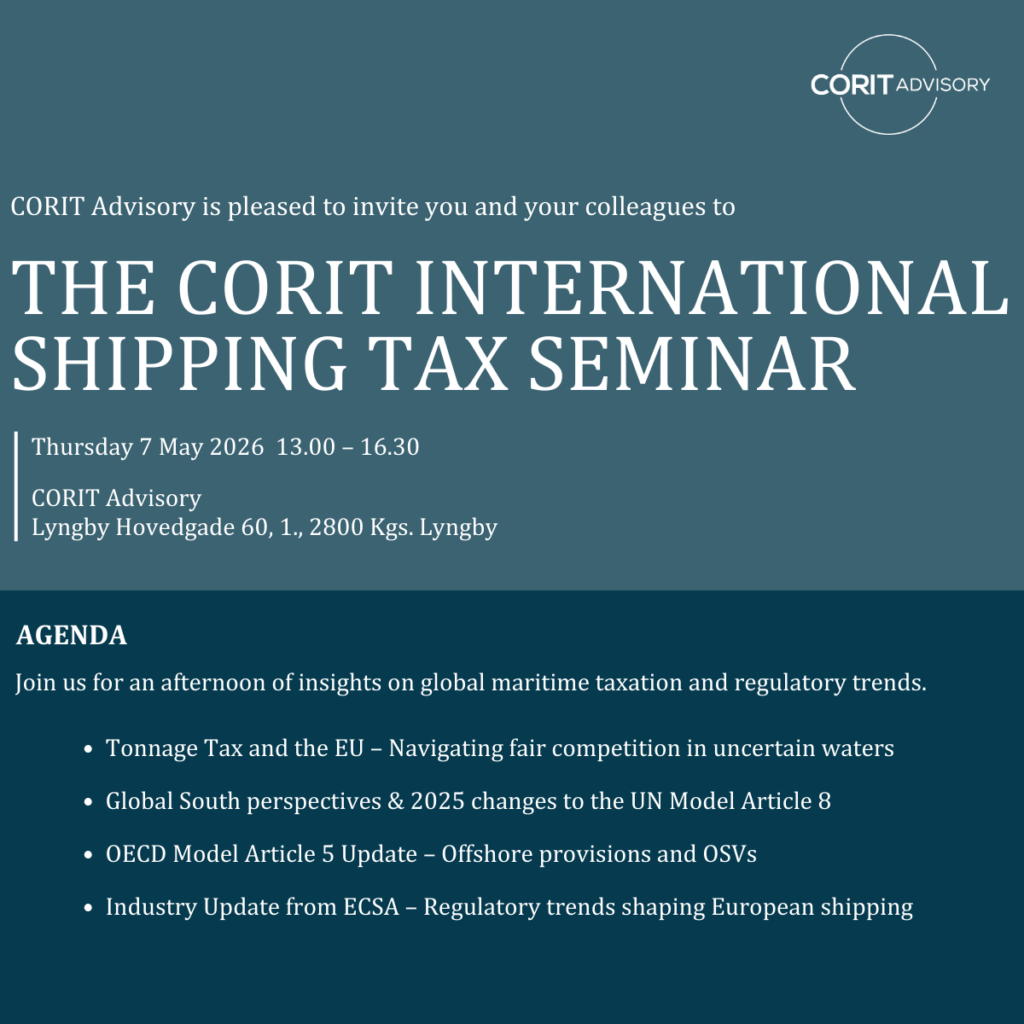
CORIT Advisory is delighted to invite you to our second International Shipping Tax Seminar, where we bring together colleagues from institutions and industry to reflect on recent developments across the EU, OECD, and UN frameworks. Our aim is to create a setting where informed perspectives can be shared openly and where participants can engage with both the technical detail and the broader policy context.
View the full agenda here.
Register here.
Event – M&A Seminar
CORIT Advisory har fornøjelsen af at invitere dig til en faglig morgenbriefing, hvor vi sætter fokus på en række aktuelle skatteproblemstillinger af relevans i forbindelse med M&A.
Seminaret er gratis og henvender sig primært til personer, der ikke beskæftiger sig med skat til daglig men som ønsker et overblik og status på centrale problemstillinger.
Tilmeldig dig på dette link.
Ved spørgsmål kan vi kontaktes på event@corit.dk.

New article by Katja Dyppel Weber, Andrea Højgaard Jørgensen and Louise Blichfeldt Fjord – Transfer Pricing Considerations on Lost Profit Potential
In the January 2026 edition of Tax Notes International, our colleagues Andrea Højgaard Jørgensen, Katja Dyppel Weber, and Louise Blichfeldt Fjord, examine the ambiguity surrounding the concept of lost profit potential in transfer pricing, particularly in the context of business restructurings.